
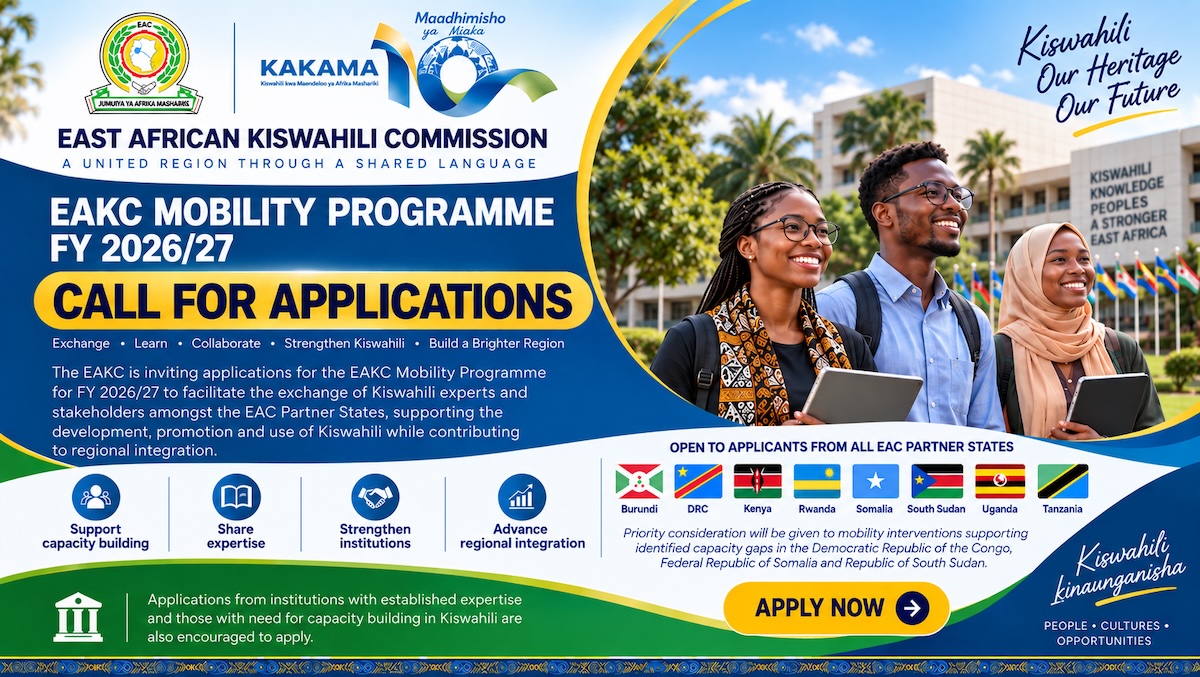
EAKC Mobility Programme FY 2026/27
Call for Applications
East African Kiswahili Commission (EAKC)
1.0 Background
The East African Kiswahili Commission (EAKC) is a specialized institution of the East African Community mandated to coordinate and promote the development and use of Kiswahili as a language of wider communication and as one of the official languages of the EAC.
The Commission invites applications for its Mobility Programme for FY 2026/27. This regional capacity-building initiative facilitates the exchange of Kiswahili expertise, knowledge, skills and good practices across EAC Partner States.
The programme responds to identified institutional, professional and technical capacity gaps and connects individuals and institutions to specific capacity needs across the region.
2.0 Purpose of the Mobility Programme
The purpose of the programme is to facilitate the exchange of Kiswahili expertise, knowledge, skills and good practices across EAC Partner States.
Specifically, the programme aims to:
- Strengthen professional and institutional capacity in the development, promotion and use of Kiswahili.
- Provide opportunities for targeted learning, mentorship and institutional support.
- Support the development and review of Kiswahili curricula, learning materials, terminology, communication resources and digital content.
- Strengthen institutional linkages, professional networks and strategic partnerships.
- Promote youth engagement and participation.
- Promote Kiswahili as a vehicle for knowledge exchange, intercultural understanding and regional integration.
3.0 Priority Areas
Applications are invited under the following priority areas:
- Kiswahili in institutional administration and professional communication.
- Curriculum development, training and instructional materials.
- Kiswahili terminology, glossaries and digital content creation.
- Language learning and professional workplace competencies.
- Institutional strengthening, policy planning, stakeholder engagement and partnerships.
- Media, communication and digital Kiswahili content.
- Culture, creative industries and youth innovation including writing, storytelling, film, music and performing arts.
4.0 Mobility Opportunities and Modalities
The programme supports different forms of mobility depending on identified capacity needs and learning objectives.
- Targeted full-time learning placements (up to two months).
- Short-term institutional programmes (up to five days).
- Materials-development placements (up to one month).
- Virtual mobility.
- Hybrid mobility where appropriate.
5.0 Target Beneficiaries
- Kiswahili experts, trainers and professionals.
- Curriculum developers and teachers.
- Government officials and administrators responsible for Kiswahili.
- National Kiswahili Councils and Associations.
- Media and communication practitioners.
- Academic and training institutions.
- Cultural and creative-sector practitioners.
- Youth and women, including youth-led and women-led organizations.
- Other relevant Kiswahili stakeholders.
6.0 Eligibility
Applications are welcome from all eight EAC Partner States:
- Burundi
- Democratic Republic of the Congo
- Kenya
- Rwanda
- Somalia
- South Sudan
- Uganda
- Tanzania
Priority consideration will be given to mobility interventions addressing identified capacity gaps in the Democratic Republic of the Congo, Somalia and South Sudan.
7.0 Application Requirements
Applicants should clearly demonstrate:
- The capacity gap to be addressed.
- The relevant priority area.
- The proposed mobility activity.
- The host institution or expert.
- Expected knowledge and skills.
- Duration.
- Expected outputs.
- Knowledge-sharing plans.
- Contribution to Kiswahili development.
- Sustainability of the activity.
8.0 Expected Outcomes
- Enhanced professional competencies.
- Strengthened institutional capacities.
- Improved curricula and learning resources.
- Increased institutional use of Kiswahili.
- Improved visibility through media and digital platforms.
- Established regional partnerships.
- Greater youth engagement.
- Enhanced intercultural understanding and regional integration.
- Development of teaching materials, policy briefs and media content.
9.0 Commitments and Responsibilities
East African Kiswahili Commission
The Commission will coordinate the programme and provide support to approved participants, including:
- Return economy-class air ticket.
- Honorarium paid in two instalments.
- Transport allowance of USD 100 for eligible road travel.
- Final payment upon submission of a signed final report endorsed by the host institution.
Honorarium Rates
- Stakeholders: USD 1,000
- Senior Lecturers and Professors: USD 1,500
- External Examination/Technical Support: USD 200 per working day (5–10 days maximum)
Applicant
- Submit a complete application before the deadline.
- Identify and secure an appropriate Host Institution.
- Obtain confirmation from the Host Institution before submission.
- Follow the agreed programme of activities.
- Submit a final report with supporting photos and recordings.
- Secure travel insurance (where applicable).
Sending Institution
- Nominate and endorse the applicant.
- Retain the applicant’s benefits during mobility.
Host Institution
- Be engaged in the development or use of Kiswahili.
- Apply to host or endorse a stakeholder.
- Propose an activity calendar.
- Provide accommodation.
- Arrange airport or station transfers.
- Provide furnished working space.
- Ensure participant safety and support.
10.0 Programme Timeline
16 September 2026
16 October 2026
02 November 2026
Maximum of 2 months (60 days)
11.0 Contact Details
The Executive Secretary
East African Kiswahili Commission (EAKC)
Opposite Zanzibar Central Library (Maisara Street)
P.O. Box 600, Zanzibar, Tanzania
☎ +255 024 2232704 / +255 024 2232722
✉ eakc-hq@eachq.org